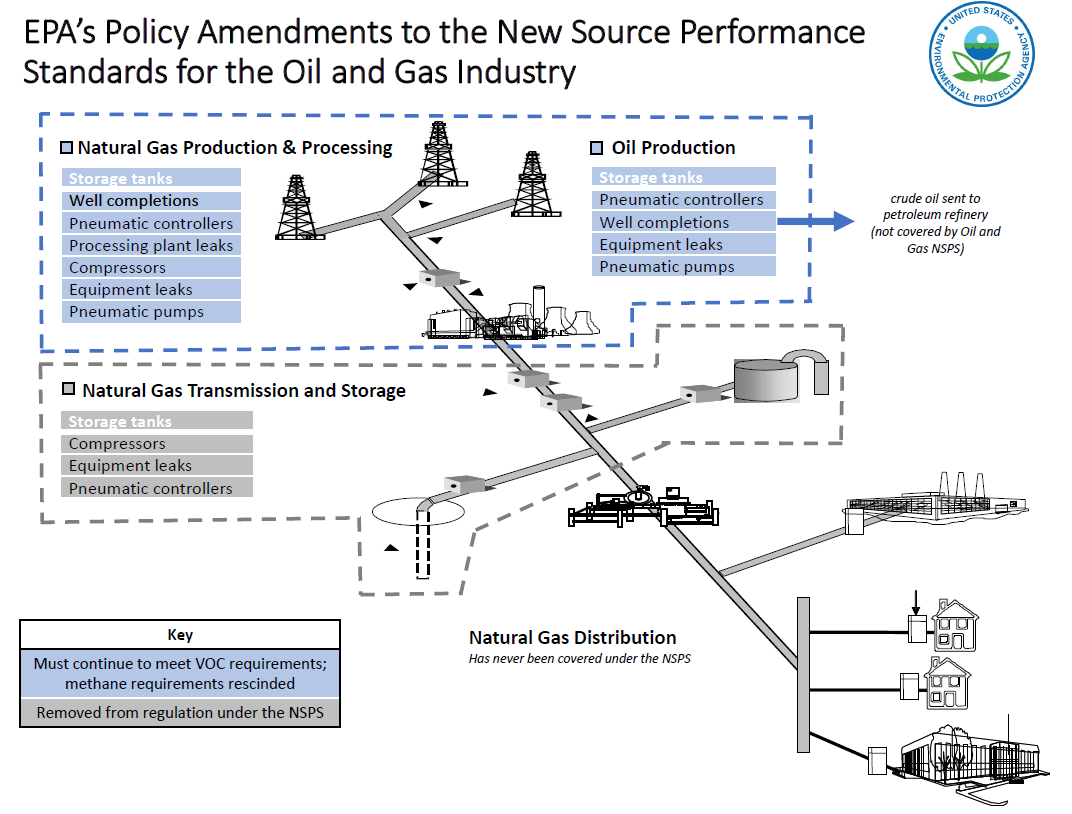
On August 13, 2020, the EPA issued two final rules related to NSPS OOOO/OOOOa that will provide benefits to small oil and natural gas producers, and will restore the rule of law to the environmental rulemaking process.
1. NATURAL GAS TRANSMISSION AND STORAGE SOURCES are no longer regulated under NSPS OOOOa.
In 1978 under the Clean Air Act, the EPA must "publish..a list of categories of stationary sources, emissions from which, in the judgment of the Administrator, cause.., or contribute.. significantly to, air pollution which may reasonably be anticipated to endanger public health or welfare." When source categories were promulgated in 1979, "Crude Oil and Natural Gas Production" was established. In the 2016 NSPS for Oil and Gas, the Obama-era EPA added "Natural Gas Transmission and Storage" sources without a formal finding that pollutants in this category significantly to air pollution. EPA has now made a final determination that transmission and storage sources are sufficiently distinct from production and processing so that the Agency erred in the 2016 Rule.
End effect: NATURAL GAS TRANSMISSION AND STORAGE SOURCES are no longer regulated under NSPS OOOOa.
2. EPA has rescinded the limits on methane emissions for the NSPS applicable to sources in the production and processing segments. EPA now finds that:" Until the EPA makes an appropriate determination that methane emissions from the Oil and Natural Gas source category, properly calculated, contribute significantly to dangerous air pollution, it does not have authority to promulgate standards of performance for methane from these sources under CAA section 111(b)(1)(b) ." However, don't let the media get you excited or in a huff: the methane requirements are completely redundant with the NSPS for VOC, and the VOC rules are staying on the books. Essentially there is no change to the requirements of the rule and no impact in the VOC or methane emission reductions achieved from these sources.
End effect: NO PRACTICAL CHANGES FOR INDUSTRY.
For a riveting read about items 1 and 2 above, here's the full 199-page Federal Register: https://www.epa.gov/sites/production/files/2020-08/documents/frn.oil.and.gas.review.2060-at90.final.20200812.admin.web.pdf
3. Technical amendments are revised to reduce overly burdensome federal overreach from the 2016 NSPS. Some notable items include:
- We've been arguing this for years, low-production wells (those that produce less than 15 bopd) are now exempted from fugitive leak monitoring.
- Fugitive monitoring at gathering and boosting compressor stations are now only required semiannually instead of quarterly.
- For tank batteries with "two or more storage vessels manifolded together with piping such that all vapors are shared between the headspace of the storage vessles, and where emissions are routed through a CVS or a control device with a DRE of at least 95%... potential VOC emissions may determined by averaging the emissions from the entire tank battery across the number of storage vessels in the battery....If the average per storage vessel VOC emissions are greater than 6 tpy, then all storage vessels in that battery are storage vessel affected facilities."This is a huge clarification!!
- There are several other technical updates, see the fact sheet here: https://www.epa.gov/sites/production/files/2020-08/documents/og.technical.amendments.fact.sheet.final..8.13.2020.pdf
and full Federal register here: https://www.epa.gov/sites/production/files/2020-08/documents/frn.og.reconsideration.2060-at54.final.rule.20200812.admin.web.pdf
For more information about these regulatory changes, email Kat Galloway at Kat@BrightSkyENV.com