Oil and condensate storage tanks are the largest source of volatile organic compound (VOC) emissions at oil and gas well sites. At all facilities across the US, these emissions would be too great to be vented directly to the atmosphere. At a minimum, these emissions would traditionally (old school) be captured and routed to a flare to be destroyed. Other air pollutants are generated during the flaring process, such as oxides of nitrogen (NOx), carbon monoxide (CO), and sulfur dioxide (SO2). In 2016, the EPA Gas Star program released a recommendation to install a vapor recovery unit (VRU) to capture, compress, and route the tank vapors to a sales line instead of routing to a flare.1.. Most regulatory agencies allow a potential-to-emit (PTE) reduction credit for a VRU installation, typically 95%. Accordingly, the use of VRUs has become widespread in the oil and gas industry.
Denver-based EcoVapor has patented and proven a new add-on skid that can increase a VRU’s capture efficiency up to a full 100%, virtually eliminating air emissions from storage tanks and significantly reducing PTE. I have interviewed Peter Mueller, co-founder of EcoVapor, to describe their capture technology.
Some background on oxygen:
Oxygen is corrosive to piping. Accordingly, most gathering and interstate pipelines reject gas streams with oxygen over 10 ppm. Oxygen is not present in the oil and gas itself as it rises from the earth in the oil and gas production process; instead, it enters the system through leaks. An improperly designed and/or operated tank VRU system is a huge potential source of oxygen.
How VRUs handle oxygen:
VRUs are frequently designed with controls to prevent pulling a vacuum on storage tanks. However, if not operating correctly, the VRU can pull a vacuum on the tank, and “air can be sucked into a tank vent line through improperly sealed roof hatches, vacuum protection valves, and similar devices..2.” Additionally, routine tank gauging, emptying tanks, and tank truck vapor capture systems can introduce oxygen into the tank headspace.
What is the ZerO2 system?
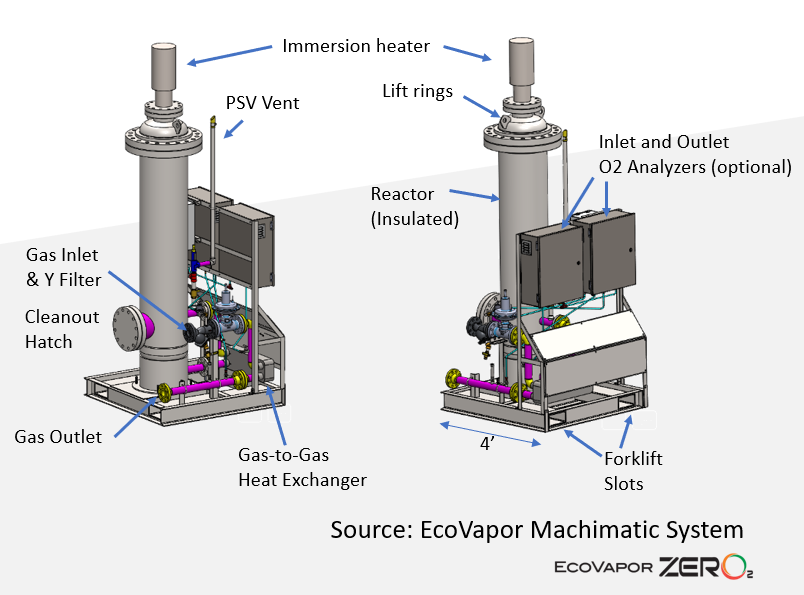
The EcoVapor ZerO2 can be described as a safety technology that is inherent to the VRU process. The system itself is a 4’ x 4’ skid equipped with a patented catalyst technology that removes oxygen from a heated gas stream. It does require 480V of power and can be added inline to an existing facility or installed with a VRU during a new facility build-out.
Benefits of the ZerO2 System in air permitting:
Recognizing the risk of oxygen entering an oil and gas system, the Texas Commission on Environmental Quality (TCEQ) typically only allows for a 95% capture efficiency for a VRU (this aligns with EPA’s 95% capture assumptions). An additional 1% efficiency up to 100% can be claimed as long as records are kept for each of the following:
- Additional sensing equipment – Inlet and Outlet oxygen sensors are available on the EcoVapor system;
- Appropriately designed bypass system – comes standard on EcoVapor system;
- Appropriate gas blanket – EcoVapor can install oxygen ingress control systems;
- Ability to vary the drive speed for VRU units utilizing electric driven compressors; and
- Records of enhanced design functions – EcoVapor can provide off-site or live-feed automation data of all systems.
I said previously that the ZerO2 system virtually eliminates air emissions from tank systems. It does this by effectively removing and monitoring the entry of oxygen into a vapor recovery system, thereby enhancing capture efficiency of a VRU. It is possible to claim up to 100% vapor capture on an air permit application if installed correctly. VRU compressors themselves need to have routine maintenance, so it is important to install a flare on-site as an emergency back-up during routine VRU compressor downtime. Sites that should consider an EcoVapor system in their facility design are:
- Central tank batteries with the potential for high tank flashing and working emissions.
- Central tank batteries with an existing VRU in-place. If a vapor recovery tower (VRT) is installed to bring tank flashing emissions down to a lower operating pressure, but you’re having problems with uptime, the ZerO2 system could be a viable replacement of a VRT altogether.
- Any oil and gas site needing additional tank vapor capture to stay below critical air permitting thresholds (i.e., Title V or PSD thresholds).
Added benefits:
The ZerO2 system is also capable of handling crude and produced water truck loading vapors. Truck loading is the second-highest source of VOC emissions at oil and gas sites. The risk of pulling oxygen during truck loading is a big safety component at a site, and this could ameliorate that problem.
These units are not in a “design phase” or a “seeking funding” phase – they are proven and employed in the field in every major producing basin in the US. For more information, including case studies, check out their website, or skip ahead to this video at the 4:00 mark.
About Bright Sky Environmental:
If you’d like assistance on how to incorporate this technology into your air permit, please feel free to reach out to me directly at Kat@BrightSkyENV.com
Bright Sky Environmental is a woman-owned environmental consulting company based in Austin, Texas. We provide environmental permitting, compliance, and diligence services to the energy industry. We seek to help operators produce oil and gas sustainably.
-Kat Galloway, President of Bright Sky
https://www.epa.gov/sites/production/files/2016-06/documents/ll.final.vap.pdf
“Oxygen Removal in Natural Gas Systems,” Rosaline Jones et. al, Trimeric Corporation.